

What Kind Of Animals Live In Antarctica
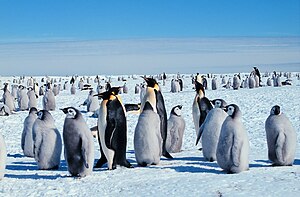
Emperor penguins (Aptenodytes forsteri) are the only animals to breed on mainland Antarctica during the wintertime.
The wild animals of Antarctica are extremophiles, having to adapt to the dryness, depression temperatures, and high exposure common in Antarctica. The extreme weather of the interior contrasts to the relatively mild conditions on the Antarctic Peninsula and the subantarctic islands, which have warmer temperatures and more liquid water. Much of the ocean effectually the mainland is covered past sea ice. The oceans themselves are a more stable environment for life, both in the h2o column and on the seabed.
There is relatively little diversity in Antarctica compared to much of the rest of the world. Terrestrial life is concentrated in areas near the coast. Flying birds nest on the milder shores of the Peninsula and the subantarctic islands. Eight species of penguins inhabit Antarctica and its offshore islands. They share these areas with seven pinniped species. The Southern Ocean effectually Antarctica is home to 10 cetaceans, many of them migratory. There are very few terrestrial invertebrates on the mainland, although the species that do live there accept loftier population densities. Loftier densities of invertebrates also alive in the ocean, with Antarctic krill forming dense and widespread swarms during the summer. Benthic animal communities besides exist around the continent.
Over k fungi species take been found on and around Antarctica. Larger species are restricted to the subantarctic islands, and the majority of species discovered have been terrestrial. Plants are similarly restricted mostly to the subantarctic islands, and the western edge of the Peninsula. Some mosses and lichens however can be found even in the dry out interior. Many algae are found effectually Antarctica, especially phytoplankton, which grade the basis of many of Antarctica'south food webs.
Human action has acquired introduced species to gain a foothold in the expanse, threatening the native wildlife. A history of overfishing and hunting has left many species with greatly reduced numbers. Pollution, habitat destruction, and climate change pose smashing risks to the environment. The Antarctic Treaty System is a global treaty designed to preserve Antarctica as a place of research, and measures from this system are used to regulate human being activity in Antarctica.
Ecology conditions [edit]

Elevation of the Antarctic terrain
Around 98% of continental Antarctica is covered in ice up to 4.vii kilometres (2.9 mi) thick.[1] Antarctica'due south icy deserts take extremely low temperatures, high solar radiation, and extreme dryness.[2] Whatsoever precipitation that does fall ordinarily falls as snow, and is restricted to a band around 300 kilometres (186 mi) from the declension. Some areas receive as trivial as 50 mm (2.0 in) of precipitation annually. The coldest temperature recorded on Earth was −89.4 °C (−128.ix °F) at Vostok Station on the Antarctic Plateau.[i] Organisms that survive in Antarctica are often extremophiles.[2]
The dry out interior of the continent is climatically unlike from the western Antarctic Peninsula and the subantarctic islands. The Peninsula and the islands are far more habitable; some areas of the peninsula tin can receive 900 mm (35.4 in) of precipitation a year, including rain, and the northern Peninsula is the only surface area on the mainland where temperatures are expected to become higher up 0 °C (32 °F) in summer.[1] The subantarctic islands take a milder temperature and more water, and so are more than conducive to life.[3]
The surface temperature of the Southern Sea varies very footling, ranging from 1 °C (33.eight °F) to i.8 °C (35.two °F).[4] During the summer sea ice covers 4,000,000 square kilometres (1,500,000 sq mi) of ocean.[v] The continental shelf surrounding the mainland is 60 to 240 kilometres (37 to 149 mi) wide. The depth of the seafloor in this surface area ranges from 50 to 800 metres (164 to ii,625 ft), with an boilerplate of 500 metres (i,640 ft). After the shelf, the continental gradient descends to abyssal plains at 3,500–v,000 metres (11,483–16,404 ft) deep. In all these areas, ninety% of the seafloor is fabricated up of soft sediments, such as sand, mud, and gravel.[6]
Animals [edit]
At least 235 marine species are found in both Antarctica and the Chill, ranging in size from whales and birds to small marine snails, sea cucumbers, and mud-dwelling worms. The big animals often migrate between the two, and smaller animals are expected to be able to spread via underwater currents.[7] Still, amid smaller marine animals by and large assumed to be the same in the Antarctica and the Arctic, more than detailed studies of each population accept oft—merely not always—revealed differences, showing that they are closely related ambiguous species rather than a unmarried bipolar species.[8] [9] [10] Antarctic animals have adapted to reduce heat loss, with mammals developing warm windproof coats and layers of blubber.[eleven]
Antarctica's common cold deserts have some of the least diverse fauna in the world. Terrestrial vertebrates are limited to sub-antarctic islands, and even then they are limited in number.[12] Antarctica, including the subantarctic islands, has no natural fully terrestrial mammals, reptiles, or amphibians. Homo activity has however led to the introduction in some areas of foreign species, such as rats, mice, chickens, rabbits, cats, pigs, sheep, cattle, reindeer, and various fish.[12] Invertebrates, such as beetle species, have besides been introduced.[13]
The benthic communities of the seafloor are diverse and dense, with up to 155,000 animals found in 1 square metre (10.8 sq ft). As the seafloor environment is very similar all around the Antarctic, hundreds of species can be found all the way around the mainland, which is a uniquely wide distribution for such a large community. Polar and deep-sea gigantism, where invertebrates are considerably larger than their warmer-water relatives, is mutual in this habitat.[6] [14] [15] These two like types of gigantism are believed to be related to the cold water, which tin incorporate high levels of oxygen, combined with the low metabolic rates ("slow life") of animals living in such cold environments.[14] [15]
Birds [edit]

The rocky shores of mainland Antarctica and its offshore islands provide nesting infinite for over 100 million birds every spring. These nesters include species of albatrosses, petrels, skuas, gulls and terns.[16] The insectivorous South Georgia pipit is owned to South Georgia and some smaller surrounding islands. Ducks, the S Georgia pintail and Eaton'southward pintail, inhabit Due south Georgia, Kerguelen and Crozet.[12]
The flightless penguins are most all located in the Southern Hemisphere (the but exception is the equatorial Galapagos penguin), with the greatest concentration located on and around Antarctica. Four of the xviii penguin species alive and breed on the mainland and its close offshore islands. Another four species live on the subantarctic islands.[17] Emperor penguins have iv overlapping layers of feathers, keeping them warm. They are the only Antarctic animal to breed during the winter.[11]
Fish [edit]
Compared to other major oceans, at that place are few fish species in few families in the Antarctic ocean.[xviii] The most species-rich family are the snailfish (Liparidae), followed by the cod icefish (Nototheniidae)[xix] and eelpouts (Zoarcidae). Together the snailfish, eelpouts and notothenioids (which includes cod icefish and several other families) account for almost nine⁄10 of the more 320 described fish species in the Antarctic ocean. Tens of undescribed species also occur in the region, especially among the snailfish. If strictly counting fish species of the Antarctic continental shelf and upper slope, at that place are more than 220 species and notothenioids boss, both in number of species (more than than 100) and biomass (more than than 90%).[18] Southern Body of water snailfish and eelpouts are more often than not constitute in deep waters, while the icefish also are common in shallower waters.[nineteen] [twenty] In improver to the relatively species-rich families, the region is habitation to a few species from other families: hagfish (Myxinidae), lamprey (Petromyzontidae), skates (Rajidae), pearlfish (Carapidae), morid cods (Moridae), eel cods (Muraenolepididae), gadid cods (Gadidae), horsefish (Congiopodidae), Antarctic sculpins (Bathylutichthyidae), triplefins (Tripterygiidae) and southern flounders (Achiropsettidae). Among fish institute south of the Antarctic Convergence, near 90% of the species are endemic to the region.[18]
Icefish [edit]
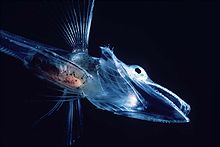
Fish of the Notothenioidei suborder, such as this young icefish, are mostly restricted to the Antarctic and Subantarctic
Cod icefish (Nototheniidae), as well as several other families, are part of the Notothenioidei suborder, collectively sometimes referred to as icefish. The suborder contains many species with antifreeze proteins in their claret and tissue, allowing them to live in water that is around or slightly below 0 °C (32 °F).[21] [22] Antifreeze proteins are also known from Antarctic ocean snailfish and eelpouts.[23] [24]
In that location are two icefish species from the genus Dissostichus, the Antarctic toothfish (D. mawsoni) and the Patagonian toothfish (D. eleginoides), which past far are the largest fish in the Antarctic ocean. These ii species live on the seafloor from relatively shallow water to depths of 3,000 m (9,800 ft), and can grow to around ii one thousand (half-dozen.6 ft) long weighing up to 100 kg (220 lb), living up to 45 years.[21] [25] The Antarctic toothfish lives shut to the Antarctic mainland, whereas the Patagonian toothfish lives in the relatively warmer subantarctic waters. Toothfish are commercially fished, and illegal overfishing has reduced toothfish populations.[21]
Another abundant icefish group is the genus Notothenia, which like the Antarctic toothfish have antifreeze in their bodies.[21]
An unusual species of icefish is the Antarctic silverfish (Pleuragramma antarcticum), which is the simply truly pelagic fish in the waters near Antarctica.[26]
Mammals [edit]

Weddell seals (Leptonychotes weddellii) are the nigh southerly of Antarctic mammals.
Seven pinniped species inhabit Antarctica. The largest, the Southern elephant seal (Mirounga leonina), can reach up to 4,000 kilograms (eight,818 lb)[4] and over 6 metres (twenty ft) long,[27] while females of the smallest, the Antarctic fur seal (Arctophoca gazella), reach just 150 kilograms (331 lb). These ii species live north of the bounding main ice, and breed in harems on beaches. The other four species tin can alive on the sea ice. Crabeater seals (Lobodon carcinophagus) and Weddell seals (Leptonychotes weddellii) grade breeding colonies, whereas leopard seals (Hydrurga leptonyx) and Ross seals (Ommatophoca rossii) live lone lives. Although these species hunt underwater, they breed on land or ice and spend a bang-up bargain of time at that place, as they accept no terrestrial predators.[4]
The four species that inhabit sea water ice are thought to make up fifty% of the total biomass of the world'due south seals.[28] Crabeater seals have a population of around fifteen one thousand thousand, making them one of the most numerous large animals on the planet.[29] The New Zealand sea king of beasts (Phocarctos hookeri), 1 of the rarest and most localised pinnipeds, breeds near exclusively on the subantarctic Auckland Islands, although historically information technology had a wider range.[30] Out of all permanent mammalian residents, the Weddell seals live the furthest due south.[31]
There are ten cetacean species found in the Antarctic ocean; six baleen whales, and four toothed whales. The largest of these, the blueish whale (Balaenoptera musculus), grows to 24 metres (79 ft) long weighing 84 tonnes. Many of these species are migratory, and travel to tropical waters during the Antarctic wintertime.[32] Orcas, which practise non migrate, notwithstanding regularly travel to warmer waters, possibly to relieve the stress the temperature has on their skin.[33]
State invertebrates [edit]

Nearly terrestrial invertebrates are restricted to the sub-Antarctic islands. Although in that location are very few species, those that do inhabit Antarctica take loftier population densities. In the more extreme areas of the mainland, such as the cold deserts, food webs are sometimes restricted to three nematode species, but 1 of which is a predator.[12] Many invertebrates on the subantarctic islands can alive in subzero temperatures without freezing, whereas those on the mainland tin can survive being frozen.[13]
Mites and springtails make up virtually terrestrial arthropod species, although various spiders, beetles, and flies can be found.[12] Several 1000 individuals from various mite and springtail species tin be found in i square metre (x.8 sq ft). Beetles and flies are the most species rich insect groups on the islands. Insects play an of import role in recycling expressionless institute material.[xiii]
The mainland of Antarctica has no macro-arthropods. Micro-arthropods are restricted to areas with vegetation and nutrients provided by the presence of vertebrates,[12] and where liquid h2o can be found.[13] Belgica antarctica, a wingless midge, is the only true insect found on the mainland. With sizes ranging from 2–6 mm (0.08–0.24 in), it is the mainland's largest terrestrial animal.[34]
Many terrestrial earthworms and molluscs, along with micro-invertebrates, such as nematodes, tardigrades, and rotifers, are likewise establish.[12] Earthworms, along with insects, are important decomposers.[13]
The springtail Gomphiocephalus hodgsoni is endemic and restricted to southern Victoria Country between Mt. George Murray (75°55′S) and Minna Bluff (78°28′Southward) and to the adjacent nearshore islands.[35] Insects endemic to Antarctica include:
- Belgica albipes, a midge
- Belgica antarctica, a midge
- Siphlopteryx antarctica, a fly
Springtail species identified in recent inquiry:[36]
- Antarcticinella monoculata
- Cryptopygus antarcticus
- Desoria klovstadi
- Friesea grisea
- Gomphiocephalus hodgsoni
- Gressittacantha terranova
- Neocryptopygus nivicolus
Mite species identified in recent inquiry:[36]
- Coccorhagidia keithi
- Nanorchestes antarcticus
- Stereotydeus mollis
- Tydeus setsukoae
Marine invertebrates [edit]
Arthropods [edit]
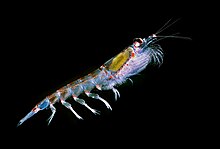
Five species of krill, small gratuitous-swimming crustaceans, are found in the Southern Ocean.[37] The Antarctic krill (Euphausia superba) is one of the nearly abundant animal species on earth, with a biomass of around 500 1000000 tonnes. Each private is half-dozen centimetres (2.4 in) long and weighs over 1 gram (0.035 oz).[38] The swarms that form can stretch for kilometres, with upward to 30,000 individuals per 1 cubic metre (35 cu ft), turning the h2o red.[37] Swarms unremarkably remain in deep water during the twenty-four hours, ascending during the night to feed on plankton. Many larger animals depend on krill for their own survival.[38] During the winter when food is scarce, adult Antarctic krill can revert to a smaller juvenile stage, using their own body equally nutrition.[37]
Many benthic crustaceans have a non-seasonal breeding wheel, and some raise their eggs and young in a brood pouch (they lack a pelagic larvae stage).[39] [40] Glyptonotus antarcticus at upward to 20 cm (8 in) in length and lxx grams (2.5 oz) in weight, and Ceratoserolis trilobitoides at upwardly to eight cm (3.1 in) in length are unusually big benthic isopods and examples of Polar gigantism.[41] [42] Amphipods are arable in soft sediments, eating a range of items, from algae to other animals.[6] The amphipods are highly diverse with more than 600 recognized species found south of the Antarctic Convergence and there are indications that many undescribed species remain. Amidst these are several "giants", such as the iconic epimeriids that are up to 8 cm (3.ane in) long.[43]
Crabs accept traditionally not been recognized every bit part of the brute in the Antarctic region, simply studies in the final few decades accept found a few species (generally rex venereal) in deep h2o. This initially led to fears (frequently quoted in the mainstream media) that they were invading from more northern regions because of global warming and possibly could cause serious damage to the native creature, simply more recent studies show they too are native and formerly but had been overlooked.[44] Nevertheless, many species from these southern oceans are extremely vulnerable to temperature changes, being unable to survive even a small warming of the water.[44] [45] Although a few specimens of the not-native bully spider crab (Hyas araneus) were captured at the Southward Shetland Islands in 1986, there have been no further records from the region.[44]
Slow moving sea spiders are common, sometimes growing up to nearly 35 cm (1 ft) in leg span (some other example of Polar gigantism).[46] Roughly xx% of the sea spider species in the earth are from Antarctic waters.[47] They feed on the corals, sponges, and bryozoans that litter the seabed.[6]
Molluscs [edit]

Many aquatic molluscs are present in Antarctica. Bivalves such as Adamussium colbecki movement effectually on the seafloor, while others such equally Laternula elliptica alive in burrows filtering the water above.[6] There are around lxx cephalopod species in the Southern Ocean,[48] the largest of which is the jumbo squid (Mesonychoteuthis hamiltoni), which at up to 14 metres (46 ft) is among the largest invertebrates in the world.[49] Squid make up most of the nutrition of some animals, such as grayness-headed albatrosses and sperm whales, and the warty squid (Moroteuthis ingens) is 1 of the subantarctic's almost preyed upon species by vertebrates.[48]
Other marine invertebrates [edit]

The red Antarctic sea urchin (Sterechinus neumayeri) has been used in several studies and has get a model organism.[50] This is by far the best-known body of water urchin of the region, but non the simply species. Amongst others, the Southern ocean is also home to the genus Abatus that burrow through the sediment eating the nutrients they find in information technology.[half dozen] Several species of breakable stars and sea stars alive in Antarctic waters, including the ecologically important Odontaster validus and the long-armed Labidiaster annulatus.[51] [52]
Two species of salps are mutual in Antarctic waters, Salpa thompsoni and Ihlea racovitzai. Salpa thompsoni is constitute in ice-free areas, whereas Ihlea racovitzai is found in the loftier breadth areas near ice. Due to their low nutritional value, they are normally only eaten by fish, with larger animals such as birds and marine mammals simply eating them when other nutrient is scarce.[53]
Several species of marine worms are found in the Southern ocean, including Parborlasia corrugatus and Eulagisca gigantea, which at lengths upwardly to 2 chiliad (6.6 ft) and 20 cm (8 in) respectively are examples of Polar gigantism.[54] [55]
Like several other marine species of the region, Antarctic sponges are long-lived. They are sensitive to environmental changes due to the specificity of the symbiotic microbial communities within them. As a outcome, they part every bit indicators of ecology wellness.[56] The largest is the whitish or boring yellowish Anoxycalyx joubini, sometimes chosen the giant volcano sponge in reference to its shape. It can reach a elevation of 2 yard (6.5 ft) and is an important habitat for several smaller organisms. Long-term ascertainment of individuals of this locally common drinking glass sponge revealed no growth, leading to suggestions of a huge age, perhaps upward to xv,000 years (making it one of the longest-lived organisms).[57] [58] Nonetheless, more than recent observations take revealed a highly variable growth charge per unit where individuals seemingly could lack any visible growth for decades, but some other was observed to increase its size past almost 30% in only two years and 1 reached a weight of 76 kg (168 lb) in about 20 years or less.[58]
Jellyfish are likewise found there, with 2 examples existence the Ross Sea jellyfish and the fiber jellyfish or giant Antarctic jellyfish. The erstwhile is minor, at xvi cm (six.3 in) in diameter, while the latter tin can have one metre bell bore and 5-metre-long tentacles.[ citation needed ]
Fungi [edit]
Fungal multifariousness in Antarctica is lower than in the residual of the earth. Individual niches, determined by environmental factors, are filled by very few species.[59] Roughly 1150 fungi species have been identified. Lichens account for 400 of these,[3] while 750 are not-lichenised.[59] Only around 20 species of fungi are macroscopic.[three]
The non-lichenised species come from 416 different genera, representing all major fungi phyla. The first fungi identified from the sub-antarctic islands was Peziza kerguelensis, which was described in 1847. In 1898 the beginning species from the mainland, Sclerotium antarcticum, was sampled. Far more terrestrial species take been identified than marine species. Larger species are restricted to the sub-antarctic islands and the Antarctic Peninsula. Parasitic species have been found in ecological situations different from the one they are associated with elsewhere, such as infecting a dissimilar type of host. Less than ii-3% of species are thought to be endemic. Many species are shared with areas of the Arctic. Nigh fungi are idea to take arrived in Antarctica via airborne currents or birds.[59] The genus Thelebolus for example, arrived on birds some times ago, but take since evolved local strains.[60] Of the non-lichenised species of fungi and closer relatives of fungi discovered, 63% are ascomycota, 23% are basidiomycota, 5% are zygomycota, and 3% are chytridiomycota. The myxomycota and oomycota make up 1% each, although they are not truthful fungi.[59]
The desert surface is hostile to microscopic fungi due to large fluctuations in temperature on the surface of rocks, which range from 2 °C below the air temperature in the winter to 20 °C above air temperature in the summer. However, the more than stable nanoenvironments inside the rocks let microbial populations to develop. Virtually communities consist of only a few species. The most studied community occurs in sandstone, and different species arrange themselves in bands at different depths from the stone surface. Microscopic fungi, especially yeasts, have been constitute in all antarctic environments.[two]
Antarctica has around 400 lichen species, plants and fungi living symbiotically.[three] They are highly adapted, and can be divided into three chief types; crustose lichens, forming sparse crusts on the surface, foliose lichens, forming leaf-like lobes, and fruticose lichens, which grow like shrubs. Species are generally divided betwixt those found on the subantarctic islands, those institute on the Peninsula, those found elsewhere on the mainland, and those with disjointed distribution. The furthest due south a lichen has been identified is 86°thirty'. Growth rates range from i centimetre (0.four in) every 100 years in the more favourable areas to ane centimetre (0.iv in) every 1000 years in the more than inhospitable areas, and commonly occurs when the lichen are protected from the elements with a thin layer of snow, which they can often absorb h2o vapour from.[61]
Lichens [edit]
Macrolichens (east.k., Usnea sphacelata, U. antarctica, Umbilicaria decussate, and U. aprina) and communities of weakly or non-nitrophilous lichens (e.g., Pseudephebe minuscula, Rhizocarpon superficial, and R. geographicum, and several species of Acarospora and Buellia) are relatively widespread in coastal water ice-free areas.[36] Sites with substrates influenced by seabirds are colonized by well-developed communities of nitrophilous lichen species such every bit Caloplaca athallina, C. citrina, Candelariella flava, Lecanora expectans, Physcia caesia, Rhizoplaca melanophthalma, Xanthoria elegans, and X. mawsonii.[36] In the Dry Valleys the normally epilithic lichen species (Acarospora gwynnii, Buellia frigida, B. grisea, B. pallida, Carbonea vorticosa, Lecanora fuscobrunnea, L. cancriformis, and Lecidella siplei) are plant primarily in protected niches beneath the rock surface occupying a cryptoendolithic ecological niche.[36] Lichen species identified in recent research:[36]
- Acarospora spp.
- Acarospora gwynnii
- Buellia spp.
- Buellia frigida
- Buellia grisea
- Buellia pallida
- Caloplaca athallina
- Caloplaca citrina
- Candelariella flava
- Carbonea vorticosa (grade. Carbonea capsulata)
- Lecanora cancriformis
- Lecanora expectans
- Lecanora fuscobrunnea
- Lecidella siplei (form. Lecidea siplei)
- Physcia caesia
- Pseudephebe minuscula
- Rhizocarpon geographicum
- Rhizocarpon superficial
- Rhizoplaca melanophthalma
- Umbilicaria aprina
- Umbilicaria decussate
- Usnea antarctica
- Usnea sphacelata
- Xanthoria elegans
- Xanthoria mawsonii
Plants [edit]

The widespread Ceratodon purpureus is a moss that inhabits areas around the globe, and reaches every bit far south as 84°30'.
The greatest plant diverseness is found on the western border of the Antarctic Peninsula.[3] Coastal algal blooms can cover upwardly to 2 square kilometres (0.77 sq mi) of the peninsula.[62] Well-adapted moss and lichen tin be constitute in rocks throughout the continent. The subantarctic islands are a more favourable environment for establish growth than the mainland. Homo activities, especially whaling and sealing, have caused many introduced species to gain a foothold on the islands, some quite successfully.[three]
Some constitute communities exist around fumaroles, vents emitting steam and gas that tin can reach 60 °C (140 °F) at around x centimetres (3.9 in) beneath the surface. This produces a warmer environment with liquid water due to melting snow and ice. The active volcano Mountain Erebus and the fallow Mount Melbourne, both in the continent'south interior, each host a fumarole. Two fumaroles also be on the subantarctic islands, one caused by a dormant volcano on Deception Island in the South Shetland Islands and one on the Southward Sandwich Islands. The fumarole on Deception Island likewise supports moss species establish nowhere else in Antarctica.[one]
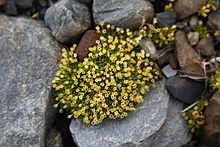
The bryophytes of Antarctica consist of 100 species of mosses, and near 25 species of liverworts.[3] While non being as widespread as lichens, they remain ubiquitous wherever plants can grow, with Ceratodon purpureus beingness found as far southward every bit 84°30' on Mount Kyffin. Different most bryophytes, a majority of Antarctic bryophytes do not enter a diploid sporophyte stage, instead they reproduce asexually or have sexual activity organs on their gametophyte phase. Only 30% of bryophytes on the Peninsular and subantarctic islands have a sporophyte phase, and simply 25% of those on the rest of the mainland produce sporophytes.[63] The Mountain Melbourne fumarole supports the simply Antarctic population of Campylopus pyriformis, which is otherwise institute in Europe and Southward Africa.[one]
Subantarctic flora is dominated by the coastal tussock grass, that tin can grow upwardly to 2 metres (7 ft). Only ii flowering plants inhabit continental Antarctica, the Antarctic hair grass (Deschampsia antarctica) and the Antarctic pearlwort (Colobanthus quitensis). Both are found merely on the western edge of the Antarctic Peninsula and on 2 nearby island groups, the South Orkney Islands and the South Shetland Islands.[3]
Mosses [edit]
The moss species Campylopus pyriformis is restricted to geothermal sites.[36]
Moss species identified in contempo research:[36]
- Anomobryum subrotundifolium
- Bryoerythrophyllum recurvirostre
- Bryum anomobryum
- Bryum pseudotriquetrum
- Campylopus pyriformis
- Cephaloziella varians
- Ceratodon purpureus
- Didymodon brachyphyllus
- Grimmia plagiopodia
- Hennediella heimii
- Pohlia nutans
- Sarconeurum glaciale
- Schistidium antarctici (form. Grimmia antarctici)
- Syntrichia princeps
Others [edit]
Bacteria have been revived from Antarctic snow hundreds of years old.[64] They have also been found deep under the water ice, in Lake Whillans, function of a network of subglacial lakes that sunlight does not achieve.[65]
A wide variety of algae are found in Antarctica, oft forming the base of operations of food webs.[66] Almost 400 species of single-celled phytoplankton that float in the water column of the Southern Ocean have been identified. These plankton bloom annually in the spring and summertime as twenty-four hours length increases and bounding main water ice retreats, before lowering in number during the winter.[64]
Other algae live in or on the bounding main ice, often on its underside, or on the seabed in shallow areas. Over 700 seaweed species have been identified, of which 35% are endemic. Exterior of the ocean many algae are institute in freshwater both on the continent and on the subantarctic islands. Terrestrial algae, such as snow algae, accept been constitute living in soil as far s as 86° 29'. Most are single-celled. In summertime algal blooms tin cause snowfall and ice to announced cherry-red, green, orange, or grayness.[66] These blooms can reach about 106 cells per mL. The dominant group of snow algae is chlamydomonas , a type of green algae.[67]
The largest marine algae are kelp species, which include bull kelp (Durvillaea antarctica), which tin can reach over 20 metres (66 ft) long and is thought to be the strongest kelp in the world. Every bit many as 47 private plants can live on 1 square metre (10.8 sq ft), and they tin can grow at threescore centimetres (24 in) a twenty-four hour period. Kelp that is broken off its anchor provides a valuable food source for many animals, too equally providing a method of oceanic dispersal for animals such equally invertebrates to travel beyond the Antarctic ocean past riding floating kelp.[68]
Conservation [edit]

Man activity poses meaning risk for Antarctic wild fauna, causing bug such as pollution, habitat destruction, and wildlife disturbance. These issues are especially acute effectually research stations.[69] Climate change and its associated effects pose significant risk to the futurity of Antarctica'southward natural environment.[lxx]
Due to the historical isolation of Antarctic wild fauna, they are easily outcompeted and threatened by introduced species, likewise brought past act.[71] Many introduced species have already established themselves,[12] with rats a particular threat, especially to nesting seabirds whose eggs they eat.[71] Illegal fishing remains an issue,[21] every bit overfishing poses a groovy threat to krill and toothfish populations. Toothfish, slow-growing, long-lived fish that have previously suffered from overfishing, are particularly at risk. Illegal fishing as well brings further risks through the use of techniques banned in regulated fishing, such as gillnetting[72] and longline fishing. These methods increase the bycatch of animals such equally albatrosses.[71]
Subantarctic islands autumn under the jurisdiction of national governments, with environmental regulation following the laws of those countries. Some islands are in addition protected through obtaining the status of a UNESCO Earth Heritage Site.[69] The Antarctic Treaty System regulates all activity in latitudes south of sixty°Southward, and designates Antarctica as a natural reserve for science.[73] Nether this system all activity must exist assessed for its ecology touch. Part of this system, the Convention for the Conservation of Antarctic Marine Living Resources, regulates fishing and protects marine areas.[69]
References [edit]
- ^ a b c d e Australian Antarctic Sectionalisation. "Plants". Government of Australia. Archived from the original on six Baronial 2012. Retrieved 21 March 2013.
- ^ a b c Selbmann, Fifty; de Hoog, Yard Due south; Mazzaglia, A; Friedmann, E I; Onofri, South (2005). "Fungi at the edge of life: cryptoendolithic black fungi from Antarctic desert" (PDF). Studies in Mycology. 51: i–32.
- ^ a b c d east f g h British Antarctic Survey. "Plants of Antarctica". Natural Environment Research Council. Archived from the original on 22 November 2012. Retrieved nineteen March 2013.
- ^ a b c Australian Antarctic Division. "Seals and sea lions". Authorities of Commonwealth of australia. Archived from the original on 19 March 2013. Retrieved 8 April 2013.
- ^ Australian Antarctic Division. "Pack-water ice seals". Authorities of Commonwealth of australia. Archived from the original on 4 August 2012. Retrieved eight April 2013.
- ^ a b c d e f Australian Antarctic Partitioning. "Seabed (benthic) communities". Regime of Australia. Archived from the original on 19 March 2013. Retrieved eight April 2013.
- ^ Kinver, Mark (fifteen Feb 2009). "Ice oceans 'are non poles autonomously'". BBC News. British Dissemination Corporation. Retrieved 22 October 2011.
- ^ Havermans, C.; G. Sonet; C. d'Udekem d'Acoz; Z. T. Nagy; P. Martin; Due south. Brix; T. Riehl; South. Agrawal; C. Held (2013). "Genetic and Morphological Divergences in the Cosmopolitan Deep-Body of water Amphipod Eurythenes gryllus Reveal a Various Abyss and a Bipolar Species". PLOS I. 8 (nine): e74218. Bibcode:2013PLoSO...874218H. doi:10.1371/periodical.pone.0074218. PMC3783426. PMID 24086322.
- ^ Hunt, B.; J. Strugnell; Northward. Bednarsek; Thou. Linse; R.J. Nelson; E. Pakhomov; B. Seibel; D. Steinke; 50. Würzberg (2010). "Poles Apart: The "Bipolar" Pteropod Species Limacina helicina is Genetically Distinct Between the Arctic and Antarctic Oceans". PLOS 1. 5 (3): e9835. Bibcode:2010PLoSO...5.9835H. doi:10.1371/journal.pone.0009835. PMC2847597. PMID 20360985.
- ^ Uriz, M.J.; J.M. Gili; C. Orejas; A.R. Perez-Porro (2011). "Do bipolar distributions exist in marine sponges? Stylocordyla chupachups sp.nv. (Porifera: Hadromerida) from the Weddell Sea (Antarctic), previously reported as S. borealis (Lovén, 1868)". Polar Biol. 34 (2): 243–255. doi:10.1007/s00300-010-0876-y. S2CID 25074505.
- ^ a b Australian Antarctic Partitioning. "Adapting to the cold". Government of Australia. Archived from the original on xviii Jan 2013. Retrieved v April 2013.
- ^ a b c d e f g h British Antarctic Survey. "Land Animals of Antarctica". Natural Surround Research Quango. Archived from the original on 22 November 2012. Retrieved eighteen March 2013.
- ^ a b c d e Australian Antarctic Sectionalization. "Land Invertebrates". Regime of Commonwealth of australia. Archived from the original on 19 March 2013. Retrieved eight Apr 2013.
- ^ a b "Polar Gigantism in Antarctica". Polar Treca. Retrieved 29 Dec 2017.
- ^ a b Chapelle, G.; L.Due south. Peck, J.T. (1999). "Polar gigantism dictated by oxygen availability". Nature. 399 (6732): 114–115. Bibcode:1999Natur.399..114C. doi:10.1038/20099. S2CID 4308425.
- ^ Australian Antarctic Division. "Flying Birds". Government of Australia. Archived from the original on xix March 2013. Retrieved 6 Apr 2013.
- ^ Australian Antarctic Division. "Penguins". Government of Australia. Archived from the original on 19 March 2013. Retrieved 6 April 2013.
- ^ a b c Eastman, J.T. (2005). "The nature of the diversity of Antarctic fishes". Polar Biol. 28 (2): 93–107. doi:10.1007/s00300-004-0667-4. S2CID 1653548.
- ^ a b Eastman, J.T.; Grand.J. Lannoo (1998). "Morphology of the Encephalon and Sense Organs in the Snailfish Paraliparis devriesi: Neural Convergence and Sensory Bounty on the Antarctic Shelf". Journal of Morphology. 237 (3): 213–236. doi:10.1002/(sici)1097-4687(199809)237:three<213::assist-jmor2>3.0.co;ii-#. PMID 9734067.
- ^ British Antarctic Survey. "Fish and Squid". Natural Environment Research Quango. Archived from the original on 9 October 2012.
- ^ a b c d e Australian Antarctic Division. "Fish". Government of Australia. Archived from the original on xix March 2013. Retrieved 5 April 2013.
- ^ Cheng, C.-H.C.; 50. Chen; T.J. Near; Y. Jin (2003). "Functional Antifreeze Glycoprotein Genes in Temperate-Water New Zealand Nototheniid Fish Infer an Antarctic Evolutionary Origin". Mol. Biol. Evol. 20 (11): 1897–1908. doi:ten.1093/molbev/msg208. PMID 12885956.
- ^ Jung, A.; P. Johnson; J.T. Eastman; A.50. Devries (1995). "Protein content and freezing avoidance properties of the subdermal extracellular matrix and serum of the Antarctic snailfish, Paraliparis devriesi". Fish Physiol Biochem. xiv (1): 71–80. doi:x.1007/BF00004292. PMID 24197273. S2CID 1792885.
- ^ Stauffer, L.B. (12 Jan 2011). "Researchers show how i factor becomes two (with different functions)". Illinois News Agency. Retrieved 29 December 2017.
- ^ Froese, Rainer and Pauly, Daniel, eds. (2017). Species of Dissostichus in FishBase. December 2017 version.
- ^ Froese, Rainer; Pauly, Daniel (eds.) (2017). "Pleuragramma antarcticum " in FishBase. December 2017 version.
- ^ "Elephant Seals | National Geographic". Animals. 2011-05-ten. Retrieved 2021-10-21 .
- ^ Australian Antarctic Division. "Pack-ice seal species". Authorities of Australia. Archived from the original on 26 August 2012. Retrieved 8 April 2013.
- ^ Australian Antarctic Division. "Salps". Authorities of Australia. Archived from the original on 19 August 2012. Retrieved viii Apr 2013.
- ^ Australian Antarctic Division. "Sea lions". Government of Australia. Archived from the original on 3 August 2012. Retrieved viii Apr 2013.
- ^ Australian Antarctic Division. "Weddell seals". Authorities of Australia. Archived from the original on 4 August 2012. Retrieved eight April 2013.
- ^ Australian Antarctic Division. "What is a whale?". Government of Australia. Archived from the original on 30 May 2012. Retrieved 8 April 2013.
- ^ Durban, J W; Pitman, R 50 (26 October 2011). "Antarctic killer whales make rapid, round-trip movements to subtropical waters: evidence for physiological maintenance migrations?". Biology Letters. viii (2): 274–277. doi:10.1098/rsbl.2011.0875. PMC3297399. PMID 22031725.
- ^ Sandro, Luke; Constible, Juanita. "Antarctic Bestiary – Terrestrial Animals". Laboratory for Ecophysiological Cryobiology, Miami University. Retrieved 18 March 2013.
- ^ Stevens, Chiliad.I.; Hogg, I.D. (2003). "Long-term isolation and recent range expansion from glacial refugia revealed for the endemic springtail Gomphiocephalus hodgsoni from Victoria Land, Antarctica". Molecular Ecology. 12 (nine): 2357–2369. doi:10.1046/j.1365-294x.2003.01907.x. PMID 12919474. S2CID 3049255.
- ^ a b c d e f 1000 h Adams, B.J. (2006). "Diversity and distribution of Victoria Land biota". Soil Biology & Biochemistry. 38 (10): 3003–3018. doi:x.1016/j.soilbio.2006.04.030.
- ^ a b c Australian Antarctic Partition. "Krill: magicians of the Southern Ocean". Government of Commonwealth of australia. Archived from the original on 29 September 2012. Retrieved 8 Apr 2013.
- ^ a b Australian Antarctic Division. "Krill". Government of Australia. Archived from the original on 22 January 2013. Retrieved eight April 2013.
- ^ Wägele, J.-W. (1987). "On the reproductive biology of Ceratoserolis trilobitoides (crustacea: isopoda): Latitudinal variation of fecundity and embryonic development". Polar Biol. 7: 11–24. doi:10.1007/BF00286819. S2CID 23794037.
- ^ Heilmayer, O.; Due south. Thatje; C. McClelland; One thousand. Conlna; T. Brey (2008). "Changes in biomass and elemental composition during early ontogenesis of the Antarctic isopod crustacean Ceratoserolis trilobitoides" (PDF). Polar Biol. 31 (xi): 1325–1331. doi:10.1007/s00300-008-0470-8. S2CID 6289689.
- ^ White, Yard.Thou. (1970). "Aspects of the breeding biology of Glyptonotus antarcticus (Eights)(Crustacea,Isopoda) at Signy Island, Southward Orkney Islands". In M.W. Holdgate (ed.). Antarctic Ecology. Vol. 1. Academic Press, London. pp. 279–285. ISBN978-0123521026.
- ^ Held, C. (2003). "Molecular evidence for ambiguous speciation within the widespread Antarctic crustacean Ceratoserolis trilobitoides (Crustacea, Isopoda)". Antarctic Biological science in a Global Context. ISBN90-5782-079-10.
- ^ d'Udekem d'Acoz, C; M.50. Verheye (2017). "Epimeria of the Antarctic ocean with notes on their relatives (Crustacea, Amphipoda, Eusiroidea)". European Journal of Taxonomy. 359 (359): i–553. doi:10.5852/ejt.2017.359.
- ^ a b c H.J. Griffiths; R.J. Whittle; Due south.J. Roberts; Thousand. Belchier; K. Linse (2013). "Antarctic Crabs: Invasive or Endurance?". PLOS Ane. eight (7): e66981. Bibcode:2013PLoSO...866981G. doi:ten.1371/journal.pone.0066981. PMC3700924. PMID 23843974.
- ^ Peck, L.S.; M.E. Webb; D.M. Bailey (2004). "Extreme sensitivity of biological function to temperature in Antarctic marine species" (PDF). Functional Ecology. xviii (v): 625–630. doi:ten.1111/j.0269-8463.2004.00903.x.
- ^ Zerehi, S.S. (7 January 2016). "Researchers have more questions than answers nearly giant sea spiders". CBC News. British Broadcasting Corporation. Retrieved 27 Dec 2017.
- ^ "Sea spiders provide insights into Antarctic evolution". Section of the Environment and Energy, Australian Antarctic Division. 22 July 2010. Retrieved 27 Dec 2017.
- ^ a b Australian Antarctic Sectionalization. "Squid". Regime of Commonwealth of australia. Archived from the original on nineteen March 2013. Retrieved 8 April 2013.
- ^ Anderton, J. (23 February 2007). "Amazing specimen of earth'due south largest squid in NZ". beehive.govt.nz. Retrieved 27 Dec 2017.
- ^ Lee, Youne-Ho (2004). "Molecular phylogeny and divergence time of the Antarctic ocean urchin (Sterechinus neumayeri) in relation to the Due south American sea urchins". Antarctic Science. xvi (1): 29–36. Bibcode:2004AntSc..16...29L. doi:ten.1017/S0954102004001786. S2CID 85233215.
- ^ Alexis M. Janosik, Alexis M.; A.R. Mahon; K.H. Halanych (2011). "Evolutionary history of Southern Sea Odontaster sea star species (Odontasteridae; Asteroidea)". Polar Biology. 34 (4): 575–586. doi:x.1007/s00300-010-0916-seven. S2CID 52850808.
{{cite periodical}}: CS1 maint: multiple names: authors list (link) - ^ Dearborn, John H.; Edwards, Kelly C.; Fratt, David B. (1991). "Nutrition, feeding behavior, and surface morphology of the multi-armed Antarctic sea star Labidiaster annulatus (Echinodermata: Asteroidea)". Marine Ecology Progress Series. 77: 65–84. Bibcode:1991MEPS...77...65D. doi:x.3354/meps077065.
- ^ Australian Antarctic Partitioning. "Salps". Government of Commonwealth of australia. Archived from the original on 19 March 2013. Retrieved 8 April 2013.
- ^ Brueggeman, P. "Nemertina, proboscis worms" (PDF). Underwater Field Guide to Ross Island & McMurdo Sound, Antarctica. Retrieved 27 December 2017.
- ^ Weisberger, M. (17 July 2017). "Bizarre Marine Worm Resembles a Christmas Ornament from Hell". LiveScience. Retrieved 27 December 2017.
- ^ Australian Antarctic Division. "Sponges". Authorities of Australia. Archived from the original on nineteen March 2013. Retrieved 8 Apr 2013.
- ^ Mohan, Yard.R. "Volcano Sponge of McMurdo Audio". AtlasObscura. Retrieved 28 December 2017.
- ^ a b Dayton; Kim; Jarrell; Oliver; Hammerstrom; Fisher; O'Connor; Barber; Robilliard; Barry; Thurber; and Conlan (2013). "Recruitment, Growth and Mortality of an Antarctic Hexactinellid Sponge, Anoxycalyx joubini". PLOS I. eight (2): e56939. Bibcode:2013PLoSO...856939D. doi:10.1371/periodical.pone.0056939. PMC3584113. PMID 23460822.
{{cite periodical}}: CS1 maint: uses authors parameter (link) - ^ a b c d Bridge, Paul D; Spooner, Brian Thou; Roberts, Peter J (2008). "Non-lichenized fungi from the Antarctic region". Mycotaxon. 106: 485–490. Retrieved 19 March 2013.
- ^ de Hoog, Thou Due south; Göttlich, E; Platas, G; Genilloud, O; Leotta, Thousand; van Brummelen, J (2005). "Evolution, taxonomy and ecology of the genus Thelebolus in Antarctica" (PDF). Studies in Mycology. 51: 33–76.
- ^ Australian Antarctic Partition. "Lichens". Regime of Commonwealth of australia. Archived from the original on 28 September 2012. Retrieved 23 March 2013.
- ^ "Antarctic algal blooms: 'Greenish snow' mapped from space". BBC News. 20 May 2020. Retrieved 25 May 2020.
- ^ Australian Antarctic Division. "Mosses and liverworts". Regime of Australia. Archived from the original on 28 September 2012. Retrieved 23 March 2013.
- ^ a b Australian Antarctic Division. "Microscopic organisms". Authorities of Australia. Archived from the original on xix March 2013. Retrieved v April 2013.
- ^ Gorman, James (6 February 2013). "Scientists Find Life in the Cold and Dark Under Antarctic Water ice". New York Times. Archived from the original on 28 Feb 2013. Retrieved 9 April 2013.
- ^ a b Australian Antarctic Sectionalization. "Algae". Government of Australia. Archived from the original on 28 September 2012. Retrieved 23 March 2013.
- ^ Australian Antarctic Division. "Snow algae". Regime of Australia. Archived from the original on 28 September 2012. Retrieved 23 March 2013.
- ^ Australian Antarctic Division. "Kelp". Government of Australia. Archived from the original on 28 September 2012. Retrieved 23 March 2013.
- ^ a b c Bridge, Paul D; Hughes, Kevin A (2010). "Conservation issues for Antarctic fungi". Mycologia Balcanica. 7 (1): 73–76.
- ^ Antarctic Conservation for the 21st Century: Background, progress, and hereafter directions (PDF), Antarctic Treaty Consultative Meeting XXXV, 11 May 2012, retrieved 9 April 2013
- ^ a b c "Threats". Earth Wildlife Fund. Retrieved 9 April 2013.
- ^ "Southern ocean fisheries". Antarctic and Southern Ocean Coalition. Archived from the original on five May 2013. Retrieved 10 February 2016.
- ^ Wright Minturn (1987). "The Buying of Antarctica, Its Living and Mineral Resource". Journal of Law and the Environment. 4.
Further reading [edit]
- Harris, C M; Lorenz, K; Fishpool, L D C; Lascelles, B; Cooper, J; Coria, N R; Croxall, J P; Emmerson, L Grand; Fijn, R C; Fraser, Due west 50; Jouventin, P; LaRue, M A; Le Maho, Y; Lynch, H J; Naveen, R; Patterson-Fraser, D L; Peter, H-U; Poncet, S; Phillips, R A; Southwell, C J; van Franeker, J A; Weimerskirch, H; Wienecke, B; Woehler, E J (2015). "Important Bird Areas in Antarctica" (PDF). BirdLife International and Environmental Inquiry & Assessment: 1–301.
Source: https://en.wikipedia.org/wiki/Wildlife_of_Antarctica
Posted by: tedrowagainto.blogspot.com
0 Response to "What Kind Of Animals Live In Antarctica"
Post a Comment