

Which Of The Following Is An Unsegmented Animal With A Free-swimming Larval Stage

Nauplius larva
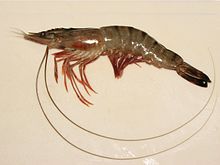
Crustaceans may pass through a number of larval and immature stages between hatching from their eggs and reaching their adult form. Each of the stages is separated by a moult, in which the hard exoskeleton is shed to let the fauna to grow. The larvae of crustaceans oft bear piffling resemblance to the adult, and in that location are still cases where it is not known what larvae volition grow into what adults. This is especially true of crustaceans which live every bit benthic adults (on the ocean bed), more-and then than where the larvae are planktonic, and thereby easily caught.
Many crustacean larvae were not immediately recognised as larvae when they were discovered, and were described every bit new genera and species. The names of these genera take become generalised to cover specific larval stages beyond wide groups of crustaceans, such as zoea and nauplius. Other terms described forms which are only found in item groups, such every bit the glaucothoe of hermit crabs, or the phyllosoma of slipper lobsters and spiny lobsters.
Life cycle [edit]
At its virtually consummate, a crustacean's life bicycle begins with an egg, which is usually fertilised, just may instead exist produced by parthenogenesis. This egg hatches into a pre-larva or pre-zoea. Through a series of moults, the young beast then passes through various zoea stages, followed by a megalopa or post-larva. This is followed past metamorphosis into an immature form, which broadly resembles the adult, and afterwards farther moults, the adult form is finally reached. Some crustaceans keep to moult every bit adults, while for others, the development of gonads signals the terminal moult.
Any organs which are absent from the adults do not generally appear in the larvae, although there are a few exceptions, such as the vestige of the fourth pereiopod in the larvae of Lucifer, and some pleopods in certain Anomura and crabs.[1] In a more extreme example, the Sacculina and other Rhizocephala have a distinctive nauplius larva with its complex body construction, but the adult grade lacks many organs due to extreme adaptation to its parasitic life mode.

Nauplius
Developed
History of the report of crustacean larva [edit]
Antonie van Leeuwenhoek was the first person to observe the difference between larval crustaceans and the adults when he watched the eggs of Cyclops hatching in 1699.[ane] Despite this, and other observations over the following decades, there was controversy amongst scientists virtually whether or non metamorphosis occurred in crustaceans, with conflicting observations presented, based on different species, some of which went through a metamorphosis, and some of which did non. In 1828 John Vaughan Thompson published a paper "On the Metamorphoses of the Crustacea, and on Zoea, exposing their singular structure and demonstrating they are not, as has been supposed, a peculiar Genus simply the Larva of Crustacea!!" However his piece of work was not believed due to crayfish not undergoing metamorphosis. [two] This controversy persisted until the 1840s, and the start descriptions of a complete series of larval forms were non published until the 1870s (Sidney Irving Smith on the American lobster in 1873; Georg Ossian Sars on the European lobster in 1875, and Walter Faxon on the shrimp Palaemonetes vulgaris in 1879).[1]
Larval stages [edit]

Nauplius [edit]
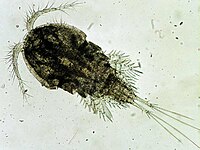
The genus proper name Nauplius was published posthumously by Otto Friedrich Müller in 1785 for animals at present known to exist the larvae of copepods. The nauplius stage (plural: nauplii) is characterised past consisting of only three head segments, which are covered by a single carapace. The posterior body, when present, is unsegmented. Each head segment has a pair of appendages; the antennules, antennae, and mandibles. This larval phase have various lifestyles; some are benthic while others are swimmers, some are feeding while others are non-feeders (lecithotrophic). The nauplius is also the stage at which a simple, unpaired eye first appears. The centre is known for that reason as the "naupliar eye", and is often absent-minded in later on developmental stages, although it is retained into the adult form in some groups, such equally the Notostraca.[3] [four]
Zoea [edit]
The genus Zoea was initially described past Louis Augustin Guillaume Bosc in 1802 for an animal at present known to exist the larva of a crab.[i] The zoea stage (plural: zoeas or zoeae) is characterised by the utilize of the thoracic appendages for swimming and a large dorsal spine.
Post-larva [edit]
The postal service-larva is characterised past the use of abdominal appendages (pleopods) for propulsion. The post-larva is unremarkably similar to the adult form, and so many names have been erected for the phase in dissimilar groups. William Elford Leach erected the genus Megalopa in 1813 for a mail service-larval crab; a copepod post-larva is called a copepodite; a barnacle post larva is called a cypris; a shrimp post-larva is chosen a parva; an hermit crab mail service-larva are called glaucothoe; spiny lobster / furry lobsters mail-larva is called a puerulus and a slipper lobster postal service-larva is called a nisto
Larvae of crustacean groups [edit]
Branchiopoda [edit]
In the Branchiopoda, the most basal grouping of crustaceans, there is no metamorphosis; instead, the animal grows through a series of moults, with each moult adding various numbers of segments to the trunk, but without any dramatic changes in grade. Every other crustacean group with free larvae shows a metamorphosis, and this departure in the larvae is thought to reverberate "a primal cleavage" of the crustaceans.[1]
Cephalocarida [edit]
In the Mediterranean horseshoe shrimp Lightiella magdalenina, the immature feel fifteen stages post-obit the nauplius, termed metanaupliar stages, and two juvenile stages, with each of the beginning six stages adding 2 torso segments, and the last four segments being added singly.[5]
Remipedia [edit]
The larvae of remipedes are lecithotrophic, consuming egg yolk rather than using external food sources. This characteristic, which is shared with malacostracan groups such as the Decapoda and Euphausiacea (krill) has been used to advise a link betwixt Remipedia and Malacostraca.[6]
Malacostraca [edit]
Amphipod hatchlings resemble the adults.[vii]
Young isopod crustaceans hatch straight into a manca phase, which is similar in appearance to the developed. The lack of a complimentary-pond larval course has led to loftier rates of endemism in isopods, but has likewise allowed them to colonise the state, in the class of the woodlice.
Stomatopoda [edit]
The larvae of many groups of mantis shrimp are poorly known. In the superfamily Lysiosquilloidea, the larvae hatch as antizoea larvae, with five pairs of thoracic appendages, and develop into erichthus larvae, where the pleopods appear. In the Squilloidea, a pseudozoea larva develops into an alima larva, while in Gonodactyloidea, a pseudozoea develops into an erichthus.[eight]
A single fossil stomatopod larva has been discovered, in the Upper Jurassic Solnhofen lithographic limestone.[9]
Krill [edit]
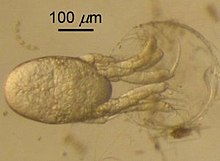
The life bicycle of krill is relatively well understood, although there are small variations in detail from species to species. Subsequently hatching, the larvae become through several stages chosen nauplius, pseudometanauplius, metanauplius, calyptopsis and furcilia stages, each of which is sub-divided into several sub-stages. The pseudometanauplius stage is exclusive to the and then-called "sac-spawners". Until the metanauplius stage, the larvae are reliant on the yolk reserves, but from the calyptopsis stage, they brainstorm to feed on phytoplankton. During the furcilia stages, segments with pairs of swimmerets are added, beginning at the frontmost segments, with each new pair just becoming functional at the adjacent moult. Subsequently the final furcilia stage, the krill resembles the developed.

Decapoda [edit]

Apart from the prawns of the suborder Dendrobranchiata, all decapod crustaceans brood their eggs on the female's pleopods. This has resulted in evolution in decapod crustaceans existence generally abbreviated.[1] There are at most nine larval stages in decapods, as in krill, and both decapod nauplii and krill nauplii often lack mouthparts and survive on nutrients supplied in the egg yolk (lecithotrophy). In species with normal development, eggs are roughly 1% of the size of the adult; in species with abbreviated development, and therefore more yolk in the eggs, the eggs may reach 1/9 of the adult's size.[ane]
The mail service-larva of shrimp is called parva, after the species Acanthephyra parva described by Henri Coutière, but which was later recognised as the larva of Acanthephyra purpurea.[10]
In the marine lobsters, at that place are three larval stages, all like in advent.
Freshwater crayfish embryos differ from those of other crustaceans in having twoscore ectoteloblast cells, rather than around 19.[11] The larvae show abbreviated evolution, and hatch with a total complement of adult appendages with the exceptions of the uropods and the showtime pair of pleopods.[1]

The larvae of the Achelata (slipper lobsters, spiny lobsters and furry lobsters) are unlike whatsoever other crustacean larvae. The larvae are known equally phyllosoma, later on the genus Phyllosoma erected past William Elford Leach in 1817. They are flattened and transparent, with long legs and optics on long eyestalks. After passing through 8–x phyllosoma stages, the larva undergoes "the well-nigh profound transformation at a unmarried moult in the Decapoda", when it develops into the so-chosen puerulus phase, which is an immature form resembling the adult animal.[one]
The members of the traditional infraorder Thalassinidea tin can be divided into ii groups on the basis of their larvae. Co-ordinate to Robert Gurney,[ane] the "homarine grouping" comprises the families Axiidae and Callianassidae, while the "anomuran grouping" comprises the families Laomediidae and Upogebiidae. This split up corresponds with the division later confirmed with molecular phylogenetics.[12]
Among the Anomura, there is considerable variation in the number of larval stages. In the South American freshwater genus Aegla, the young hatch from the eggs in the adult form.[1] Squat lobsters pass through four, or occasionally 5, larval states, which have a long rostrum, and a spine on either side of the carapace; the first post-larva closely resembles the developed.[1] Porcelain venereal take ii or three larval stages, in which the rostrum and the posterior spine on the carapace are "enormously long".[1] Hermit crabs laissez passer through around four larval stages. The post-larva is known every bit the glaucothoe, after a genus named by Henri Milne-Edwards in 1830.[1] The glaucothoe is iii millimetres (0.12 in) long in Pagurus longicarpus, just glaucothoe larvae upward to 20 mm (0.79 in) are known, and were once thought to correspond animals which had failed to develop correctly.[1] Similar the preceding stages, the glaucothoe is symmetrical, and although the glaucothoe begins equally a gratuitous-swimming grade, it oftentimes acquires a gastropod shell to live in; the coconut crab, Birgus latro, always carries a shell when the immature brute comes ashore, just this is discarded after.[i]
Zoea

Juvenile
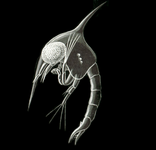
Although they are classified as crabs, the larvae of Dromiacea are similar to those of the Anomura, which led many scientists to place dromiacean crabs in the Anomura, rather than with the other crabs. Apart from the Dromiacea, all crabs share a similar and distinctive larval course. The crab zoea has a slender, curved abdomen and a forked telson, but its most striking features are the long rostral and dorsal spines, sometimes augmented by farther, lateral spines.[1] These spines can be many times longer than the trunk of the larva. Crab prezoea larvae take been found fossilised in the breadbasket contents of the Early on Cretaceous bony fish Tharrhias.[13]
Maxillopoda [edit]
Copepoda [edit]
Copepods have half-dozen naupliar stages, followed by a stage called the copepodid, which has the same number of torso segments and appendages in all copepods. The copepodid larva has two pairs of unsegmented pond appendages, and an unsegmented "hind-trunk" comprising the thorax and the belly.[1] At that place are typically v copepodid stages, but parasitic copepods may stop afterward a single copepodid stage. Once the gonads develop, there are no further moults.[i]
Parasitic copepods [edit]

Starting time chalimus of Lepeophtheirus elegans Gusev, 1951 (Copepoda, Caligidae):
A, leg three;
B, leg iii (other specimen);
C, leg 4;
D, caudal ramus;
Due east, habitus of putative female, dorsal.
Scale bars: A–D = 0.025 mm; Eastward = 0.two mm.[14]
Chalimus (plural chalimi) is a phase of development of a copepod parasite of fish, such as the salmon louse (Lepeophtheirus salmonis).[15] [16]
Chalimus Burmeister, 1834 is also a synonym for Lepeophtheirus Nordmann, 1832.
 | Await up Chalimus in Wiktionary, the gratis dictionary. |
Facetotecta [edit]
The single genus in the Facetotecta, Hansenocaris, is merely known from its larvae. They were first described by Christian Andreas Victor Hensen in 1887, and named "y-nauplia" by Hans Jacob Hansen, assuming them to exist the larvae of barnacles.[17] The adults are presumed to be parasites of other animals.[18]
Encounter also [edit]
- Ichthyoplankton
- Marine larval ecology
References [edit]
- ^ a b c d due east f grand h i j g l m n o p q r s Robert Gurney (1942). Larvae of decapod crustacea (PDF). London: Ray Club. pp. 1–306.
- ^ Nicolson, Adam (2021). "Crab". Life Between the Tides (1 ed.). New York: Farrar, Straus and Giroux. pp. 116–118. ISBN9780374251437.
- ^ Crustaceamorpha: Metamorphosis and Larvae - UCMP Berkeley
- ^ Key for the identification of crustacean nauplii - Academia.edu
- ^ Alberto Addis; Francesca Biagi; Antonello Floris; Emiliana Puddu; Marcella Carcupino (2007). "Larval development of Lightiella magdalenina (Crustacea, Cephalocarida)". Marine Biological science. 152 (three): 733–744. doi:ten.1007/s00227-007-0735-8. S2CID 85246439.
- ^ Stefan Koenemann; Jørgen Olesen; Frederike Alwes; Thomas Iliffe; Mario Hoenemann; Petra Ungerer; Carsten Wolff; Gerhard Scholtz (2009). "The post-embryonic development of Remipedia (Crustacea)—additional results and new insights". Development Genes and Evolution. 219 (3): 131–145. doi:10.1007/s00427-009-0273-0. PMID 19184096. S2CID 11575617.
- ^ "The Biology of Amphipods". Museum Victoria. Archived from the original on September 18, 2010. Retrieved June 7, 2010.
- ^ S. T. Ahyong; J. K. Lowry. "Stomatopoda: Families". World Crustacea. Australian Museum. Archived from the original on Dec xiv, 2010. Retrieved June six, 2010.
- ^ Joachim T. Haug; Carolin Haug; Manfred Ehrlich (2008). "First fossil stomatopod larva (Arthropoda: Crustacea) and a new mode of documenting Solnhofen fossils (Upper Jurassic, Southern Germany)" (PDF). Palaeodiversity. 1: 103–109.
- ^ Kemp, Stanley Westward. (1907). "XI. Biscayan Plankton. Part XI.-Decapoda". Transactions of the Linnean Lodge of London. 2nd Serial: Zoology. x (8): 205–217. doi:10.1111/j.1096-3642.1907.tb00072.x.
- ^ G. Scholtz; S. Richter (1995). "Phylogenetic systematics of the reptantian Decapoda (Crustacea, Malacostraca)". Zoological Periodical of the Linnean Society. 113 (iii): 289–328. doi:10.1006/zjls.1995.0011.
- ^ Sammy De Grave; N. Dean Pentcheff; Shane T. Ahyong; et al. (2009). "A classification of living and fossil genera of decapod crustaceans" (PDF). Raffles Bulletin of Zoology. Suppl. 21: ane–109. Archived from the original (PDF) on 2011-06-06.
- ^ John K. Maisey & Maria da Gloria P. de Carvalho (1995). "First records of fossil sergestid decapods and fossil brachyuran crab larvae (Arthropoda, Crustacea), with remarks on some supposed palaemonid fossils, from the Santana Formation (Aptian-Albian, NE Brazil)" (PDF). American Museum Novitates (3132): 1–20.
- ^ Venmathi Maran, Balu Alagar; Moon, Seong Yong; Ohtsuka, Susumu; Oh, Sung-Yong; Soh, Ho Immature; Myoung, Jung-Goo; Iglikowska, Anna; Boxshall, Geoffrey Allan (2013). "The caligid life bicycle: new evidence from Lepeophtheirus elegans reconciles the cycles of Caligus and Lepeophtheirus (Copepoda: Caligidae)". Parasite. 20: 15. doi:10.1051/parasite/2013015. PMC3718518. PMID 23647664.

- ^ The salmon louse Lepeophtheirus salmonis (Copepoda: Caligidae) life cycle has only two chalimus stages. LA Hamre, C Eichner, CMA Caipang, ST Dalvin…, PLOS One, 2013
- ^ Ultrastructure of the frontal filament in chalimus larvae of Caligus elongatus and Lepeophtheirus salmonis from Atlantic salmon, Salmo salar. AW Pike, K Mackenzie, A Rowand, Pathogens of wild and farmed fish: body of water lice, 1993
- ^ E. A. Ponomarenko (2006). "Facetotecta – unsolved riddle of marine biology". Russian Periodical of Marine Biology. 32 (Suppl. ane): S1–S10. doi:10.1134/S1063074006070017. S2CID 2943845.
- ^ Gerhard Scholtz (2008). "Zoological detective stories: the case of the facetotectan crustacean life cycle". Periodical of Biology. seven (5): 16. doi:10.1186/jbiol77. PMC2447532. PMID 18598383.
Source: https://en.wikipedia.org/wiki/Crustacean_larva
Posted by: tedrowagainto.blogspot.com
0 Response to "Which Of The Following Is An Unsegmented Animal With A Free-swimming Larval Stage"
Post a Comment